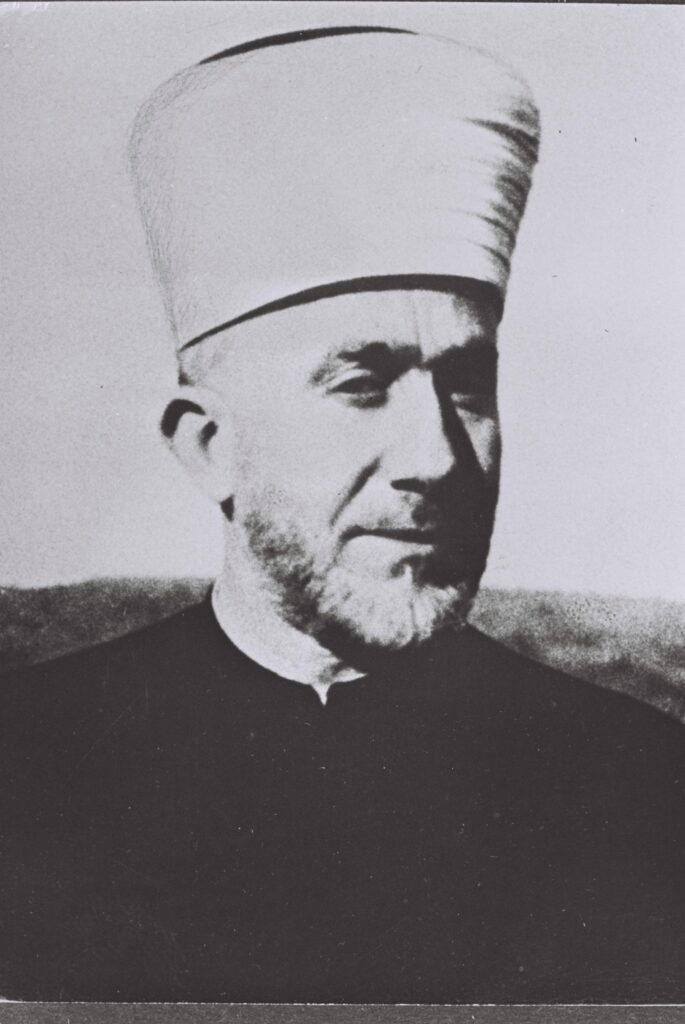
Amin al-Husseini
Mohammed Amin al-Husseini was born in Jerusalem in 1895 to a family whose prominence dates to the 16th century. There is contention among Islamic scholars as to the origins of the Husseini family. Did they immigrate to the Sharafat Village north of Jerusalem from Yemen in the 16th century? Or are they descendants of the Husseini family, which dates to Hussein, son of Khalif Ali and daughter of Prophet Muhammed, Fatima? Scholars believe it to be the Yemen theory, as the Husseini family arrived with the additional name of al-Aswad.[1] In the late 19th century, Mustafa Aswad al-Husseini, grandfather of Amin al-Husseini, married into the Jarallah family. The Jarallah family is known to have traditionally held the office of Mufti in Jerusalem. When the head of the Jarallah family died, Mustafa received political backing to become the next Mufti, thus causing the family to drop Aswad in their name. Mustafa was succeeded by his son, Taher (Amin’s father), and later by Amin’s Brother, Kamel, who served as the Mufti until he died in 1921.
From a young age, Amin was groomed to follow in his family’s footsteps and one day hold the office of the Mufti. He was sent to school at a Muslim school in Jerusalem and eventually, in 1912, began attending Al Azhar University in Cairo. Al Azhar is a prominent Islamic University in the Muslim world. Scholars believe that Amin did not study long at Al Azhar, as he left Egypt in 1915 to pursue the Islamic pilgrimage to Mecca to see the Kabba.[2] In the Islamic faith, those who seek pilgrimage at the holy site in Mecca receive the title of Haj. In some way, in the eyes of Husseini, this gave him a sort of legitimacy in the Islamic faith. After the outbreak of World War I, [Haj] Amin al-Husseini entered the military training College of Istanbul, where, upon graduation, he joined the Ottoman military with forces in Izmir.
How Husseini became the Mufti of Jerusalem
Haj Amin al-Husseini was medically dismissed from the military and returned to Jerusalem in 1917. It is believed with his Islamic education that, Husseini had been taught to detest the arriving Jews and Zionists in Palestine during the British Mandate.[3] In 1918, after the British occupation of Palestine, members of the Husseini family established El Nadi al Arabi (The Arab Club). The aims of the Nadi are “Arab independence union of Palestine with Syria, and prevention of any and every sort of Zionism and Jewish immigration.” By 1920, Husseini held various positions throughout Jerusalem and with the help of the Arab Club, began staging riots in the streets. Many Jews were slaughtered in the riots of 1920, and an arrest warrant was issued for Husseini. While seeking refuge in Transjordan, a sentence was delivered in his absence of ten years in prison. In 1921, Husseini received a full pardon from the British High Commissioner, Sir Herbert Samuel.
Sir Herbert Samuel was a Jew, but he was also British. To maintain order and discipline within greater Palestine, he needed to show impartiality, and his pardon of Husseini showed no ill will toward a common enemy.[4] Shortly after the Husseini’s pardon, Kamel el Husseini, the Mufti of Jerusalem, passed away, and there needed to be a successor. While the list of candidates was short, Haj Amin’s name was on top. Arabs within Palestine were against Haj Amin taking this position, mainly due to his failure to complete an Islamic education at Al Azhar, as a mufti is an Islamic scholar who carries political weight to rule in various aspects. However, Haj Amin’s pardon came with friends in high places, and the British authorities secured his placement as the new Mufti of Jerusalem.
Corruption
It was not enough to claim the title of Mufti for Husseini. A few months after Husseini’s appointment as the mufti, The Muslim Council was looking for a president who would be vested in religious leadership over the Palestinian Arabs. Other prominent Palestinians were striving to claim the presidency of this council, and ultimately, Husseini placed fourth in the election for the presidency, placing him outside the limits of eligibility. This did not deter him, for he used gerrymandering and threats to make the man who placed third in the race back out. Now that he was in the zone of selection, the High Committee selected Husseini as the next president of the Supreme Muslim Council. Pearlman says, “For he was now formally rehabilitated, he was a Haj, a Mufti, and President of the Supreme Moslem Council. With a little cunning and a good deal of ruthlessness, he could perhaps become the most powerful Arab in the country.”[5]
According to the Peel Commission, there were no legal limitations to the presidency of the Supreme Moslem Counsel (SMC). Husseini used this to his advantage and stated that he had a lifetime appointment to this position. Additionally, Husseini claimed control of the Sharia Court and use of Waqf funds. Written fifteen years later, the Peel report says, “the existence of the Supreme Moslem Council need not, in itself, have led to the development of an Arab ‘imperium in imperio.’”[6]
The Waqf funds in Islam are assets that are donated or purchased for being held in trust for general or specific charitable causes. These funds improve the economy and public works and are regulated by the government, or in this case, the Supreme Muslim Council. Before the election for a new president, the council concluded in 1920 that funds left from the Ottoman Empire should be left to the waqf funds and regulated by the president. Husseini, as president, dictated that he should have sole control of the funds and began keeping them for himself. From 1920 to 1937, when Husseini was removed from his position, the funds increased from £50,000 to £65,000. Taggar says, “The control of such big sums of money was a mighty instrument for the advancement of his personal and political ends.”[7]
With Husseini now in charge of all critical parts of the Palestinian Arab government, he was unstoppable. He began appointing judges to the Sharia court to ensure his ability to get away with what he pleased. This Mufti wanted a revival of the Caliphate, and an American foreign correspondent went as far as to call him “His Eminence” when speaking with the president of Al Azhar University in Cairo.
In 1936, the Supreme Muslim Council remained as it did in 1921, with Husseini as the all-powerful president. 1936 was also a critical year as it saw the beginning of the Arab Revolt. This revolt can be referred to as the “third intifada,” as it was another Arab massacre of Jewish settlers in Palestine. There was no decisive action against Husseini and his followers until the murder of Lewis Andrews, the British district commissioner for the Galilee. The most consequential action came on September 30, 1937, when the British outlawed the Arab Higher Committee, an organization developed by Mufti al-Husseini as a league of Arab leaders from other states. This led to the capture and expulsion of the mufti and several of his other Palestinian leaders. Disguising himself as a woman, al-Husseini escaped Palestine by boat and arrived in Beirut to begin exile.
Affiliation with other violence in the Middle East
While the mandatory government in Palestine forbade the mufti from returning, he was in Beirut plotting and planning his next move. The ex-mufti had comfort in Beirut being close to Palestine geographically; he was tasked with creating a united Middle East against the British by Adolf Hitler. In Rome, Benito Mussolini cautioned against establishing this singular Middle East and advised that the states remain independent just as they are in Europe. Husseini chose Germany’s plan and began his outreach. With eyes set on Baghdad, Husseini started communications with the head of the Iraqi Cabinet, Rashid Ali. Husseini used the current conflict transpiring with the British and French in Syria as a distraction to make his way to Baghdad to set pieces in place to convince the Iraqi government to align with Nazi Germany. Arab states pursued included Iraq, Transjordan, Saudi Arabia, and Syria, with Haj Amin al-Husseini as the supreme leader or the Hitler of the Middle East. The new Arab supremacy would rival that of Egypt, giving Egypt the option to become an ally.
In Iraq, there was contention between Rashid Ali, who was at Husseini’s elbow,[8] and the pro-British cabinet members. Upon hearing plans to overthrow the occupation of Iraq, pro-British cabinet members threatened to tell the British of Ali’s plans. In a late-night meeting between Husseini and Rashid Ali, Husseini gave instructions that would lead to the arrest of the dissenting cabinet members. Rashid Ali proceeded with the plans, knowing this could lead to a civil war. In a cabinet meeting, Ali was thwarted and taunted by fellow members. Acknowledging that he had lost the trust of his cabinet, he resigned, delivering another loss to Husseini’s plans.
This defeat did not last long, as Husseini increased his propagandist efforts. With the backing of his Nazi friends, Husseini once again took on the pro-British establishment now that he stood in the political wilderness. With swift action, in April 1941, Husseini succeeded, and Rashid Ali was reinstated as the Regent and now supreme ruler and dictator in Iraq. The British were also quick to act, and after several weeks of fighting, the Regent was ousted, and a new cabinet was formed under Jamil Madfai. Pearlman says, “Rashid Ali was let down by the Mufti. And the Mufti had been let down by his German friends, whose preoccupations in Greece and Crete had seriously upset their timetable.”[9] It was now time for the Mufti and Rashid Ali to turn their eyes east at Nazi-sympathetic Iran.
Iran proved difficult for Husseini, as the British were beginning movements in the South, and the Soviets were fighting in the North. Allied powers saw this as an opportunity to capture the Mufti and finally end his reign of terror. Upon arrival in Tehran, Husseini sought refuge with the Bulgarians and finally in the Japanese legation. Silence fell upon the ex- mufti’s whereabouts when it seemed he might be trapped in Tehran. The British believed he might move East toward Afghanistan since he appeared to travel in that direction in the past. Weeks later, Husseini appeared in South Italy and was welcomed by Benito Mussolini. In the Daily Express, British humor columnist, Beachcomber wrote, “We hid our eyes, and counted up to a hundred, but the Mufti shouted ‘Cuckoo!’ before we had reached forty-seven and ran away.”[10]
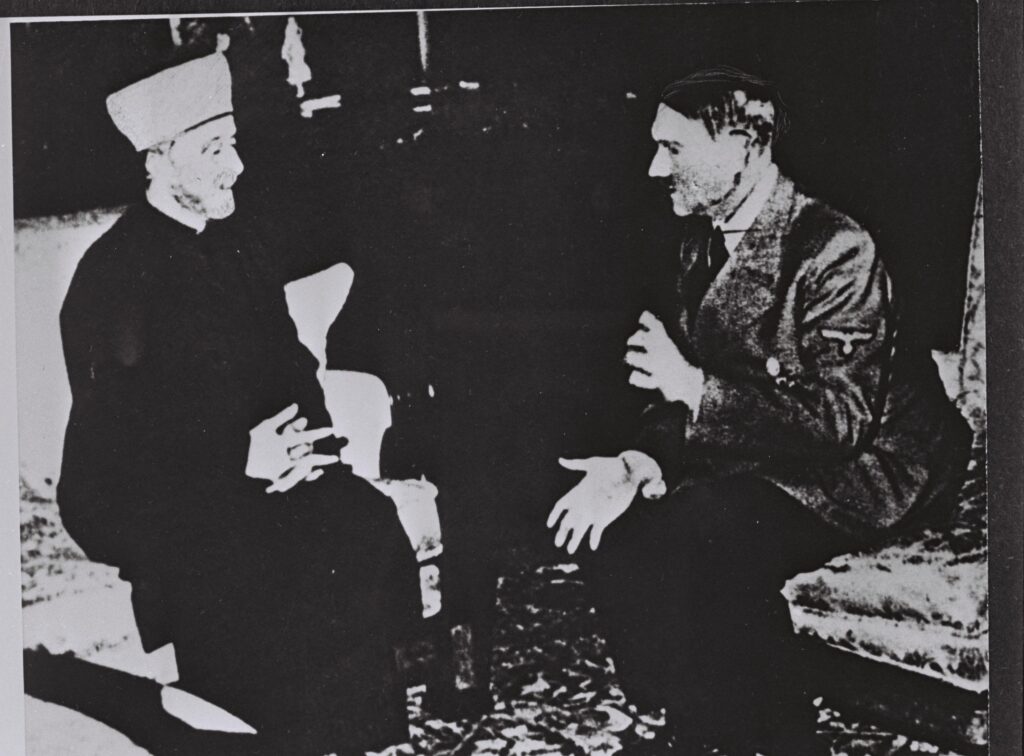
Meetings with Benito Mussolini and Adolf Hitler
In 2014, Israeli Prime Minister Benjamin Netanyahu accused the Mufti of convincing Hitler to kill Jews in Europe. The imprisonment and murder of Jews began in June 1941, and the Mufti did not meet with Hitler until November. This thwarts Netanyahu’s claim, but there was still an agenda behind Husseini’s meeting with Hitler in 1941.
Husseini’s meeting with Axis powers began after escaping Tehran and traveling to Rome. Benito Mussolini greeted him with open arms and allowed him to open an office and have staff. Husseini used this time to write letters to his followers back in Palestine and reach out to Muslims throughout Europe to convince them to join his cause. After only a few weeks of work in Italy, Husseini decided to meet Adolf Hitler himself. On November 9, Husseini arrived in Berlin and was greeted by crowds of Germans. It seemed as if Husseini had finally achieved the recognition he had craved since embarking on his political journey in 1921.
The goal of the meeting between ex-Mufti Haj Amin al-Husseini and Adolf Hitler was to discuss the issue of “Jewry” as well as their conflicts with the British and the Soviet Union. Husseini came to Hitler with hopes that the Fuhrer would make a declaration in favor of the Arab people and an Arab alliance in the Middle East. Any declaration from Hitler would bring hope to the Arabs in the eyes of Husseini. Hitler and his aids, like Henrich Himmler, pledged support for the Arab people. In his diary, Husseini noted that Hitler claimed, “I (Hitler) have made very few declarations in my life, unlike the British who have made many declarations. If I issue a declaration, I will uphold it.”[11] In records of the meeting between Hitler and the Mufti from November 1941, Hitler made the following statements:[12]
- He (the Fuhrer) would carry on the battle to the total destruction of the Judeo-Communist Empire in Europe.
- At some moment which was impossible to set exactly today but which in any event was not distant, the German armies would in the course of this struggle reach the southern exit of Caucasia.
- As soon as this happened, the Fuhrer on his own give the Arab world the assurance that its hour of liberation had arrived. Germany’s objective would then be solely the destruction of the Jewish element residing in the Arab sphere under the protection of the British power. In that hour the Mufti would be the most authoritative spokesman for the Arab world. It would then be his task to set off the Arab operations which he had secretly prepared. When that time had come, Germany would also be indifferent to French reaction to such a declaration.
Because of this declaration by Adolf Hitler, Husseini now had the vested authority from the Fuhrer to begin recruitment in Europe. He remained in Germany until 1945 and participated in anti-Jewish meetings and broadcasts over German radio. He also established an Arab legion to fight alongside the Germans.
[1] Taggar, The Mufti of Jerusalem and Palestine: Arab Politics, 1930-1937, 10
[2] This is referenced in Taggar’s The Mufti of Jerusalem and Palestine Arab Politics, and Pearlman’s The Mufti Over the Middle East
[3] Ibd.
[4] Pearlman, The Mufti Over the Middle East, 6.
[5] Pearlman, The Mufti Over the Middle East, 7.
[6] The Peel Report, 1937
[7] Taggar, The Mufti of Jerusalem and Palestine: Arab Politics, 1930-1937, 32.
[8] Pearlman describes Rashid Ali as being the elbow of the Grand Mufti. This indicates how close Husseini kept his political pawns to achieve his victories. Pearlman, The Mufti Over the Middle East, 32.
[9] Pearlman, The Mufti Over the Middle East, 33.
[10] Beachcomber wrote this Daily Express article to describe the number of attempts by the British to catch the ex-Mufti as he made his way West. This article was written the same day Husseini appeared in Rome after weeks of silence. As quoted in Pearlman, The Mufti Over the Middle East, 34.
[11] Quoted from Husseini’s diary with his recollection of the meeting between Husseini and Hitler. Found in Dalin et al., Icon of Evil: Hitler’s Mufti and the Rise of Radical Islam, 162.
[12] From the Record of the Meeting of the Grand Mufti and Adolf Hitler on November 28, 1941.
