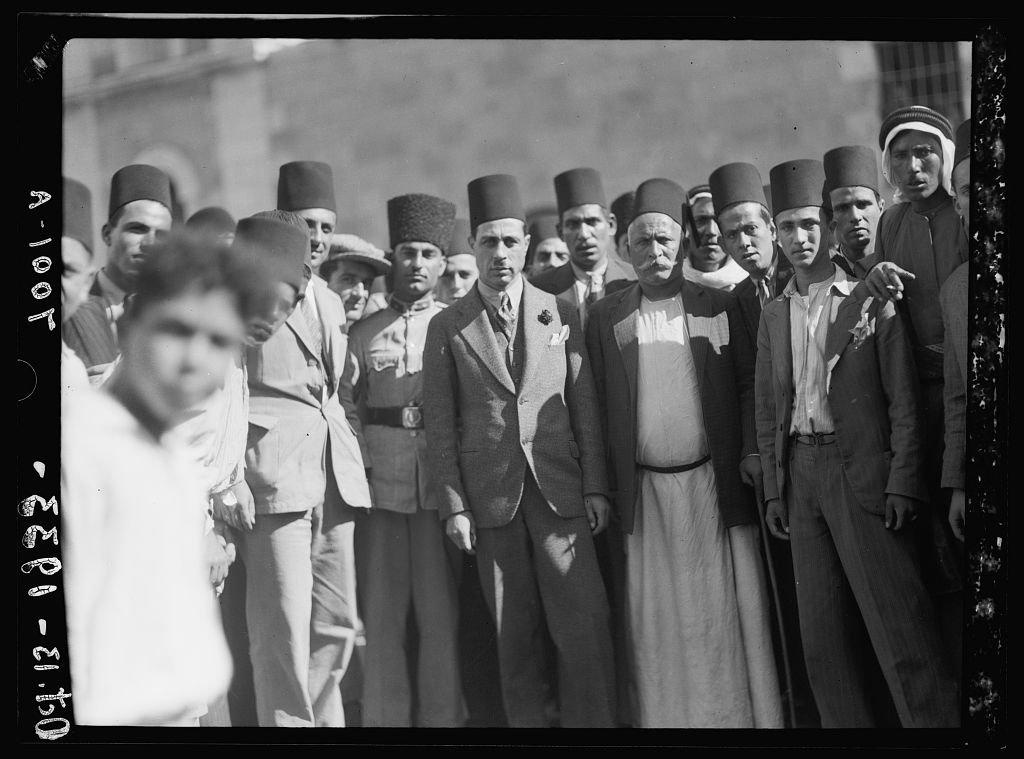
Who dissented against the Mufti?
Arabs who dissented against the will of the Mufti often found themselves in dire life-and-death situations. There were Arabs who saved Jews from the Nazis, like Khaled Abd al-Wahab, mentioned as Righteous of the Nations in Robert Satloff’s Among the Righteous.[1] Still, the families of these people did not wish to tell the tales of their loved one’s heroism due to fear of persecution by their fellow Arabs. Rene Wildangel says this is “An indication of how the ongoing conflict in the Middle East has shaped Arab memory and pushed aside many historical experiences.”
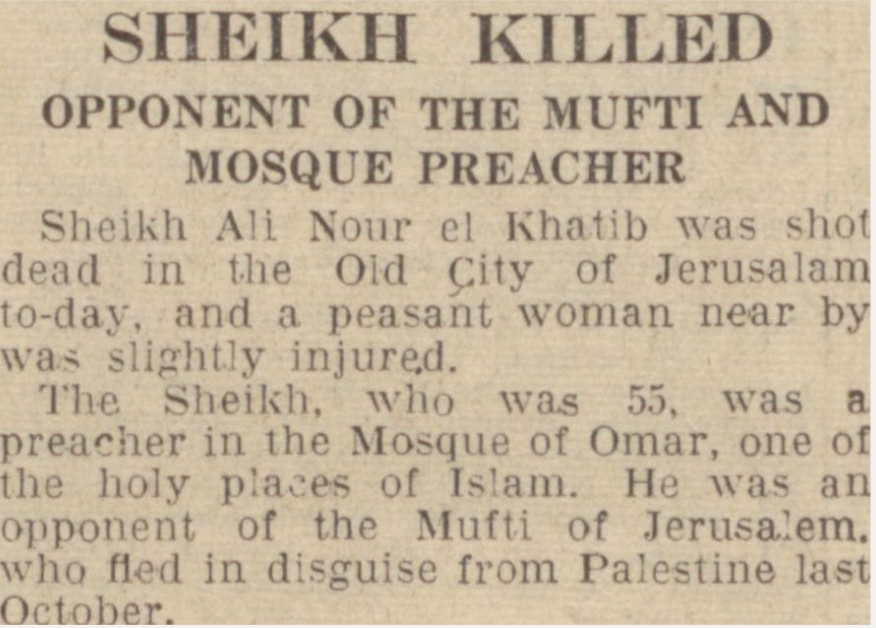
Stories like that of Khaled Abd al-Wahab and Fakhri Nashashibi are essential because they complicate the narrative of Arab-Jewish relations during the 1930s. Nashashibi was painted as a criminal who had committed the crime of High Treason for being outspoken toward the Mufti of Jerusalem. This judgment was made by Aref Abdul Razzik, a member of the Tribunal of the Great Arab Revolution, another tribunal organized by the Grand Mufti. While Nashashibi was outspoken on Jewish immigration from Europe, he was painted as a sympathizer due to his complaints about the Mufti’s corruption within the Palestinian government. Islamic leaders like Sheikhs also fell victim to murder at the hands of Husseini’s followers for being outspoken against the Mufti. Sheikh Ali Nour El Khatib was shot dead in Jerusalem in July of 1938. He was an opposer of the Mufti and a preacher at the Mosque of Omar, the mosque Husseini often frequented.
The president of Al Azhar University in Cairo was also vocally against Husseini’s claim to be an Islamic leader. He slighted the Mufti’s claim to be the “Grand Mufti,” stating that there was no such thing in Islamic law. He also opposed Husseini being called “His Eminence,” feeling that he did not deserve that title. The university’s president looked at Husseini as a heretic with his claims to Islamic leadership without the proper scholarly credentials. It is not known if there was retaliation against this man, but this became a common consensus with educated Arabs within Mandated Palestine.
In Hebron, the local mayor or mufti and other educated notables supported Great Britain’s efforts in the region. During the celebration of Nabi Musa, a festival the British decided to postpone due to the ongoing conflict in Europe, a city council member shouted, “The Satan is in Iraq Now,”[2] about Husseini’s efforts to overturn the pro-British Iraqi Cabinet. The mayor in Hebron knew that the insurgency in Iraq would fail and was convinced that even if Husseini were to get full support from the Germans, who would ultimately be defeated in the war.
Arab newspapers were staunch in their opposition to the war started by Germany. Al-Ghad warned that Palestine was threatened at the prospect of Germany prevailing, stating, “If Fascism will prevail, and the Arab lands will be enslaved with iron and fire, our struggle for independence will be set back for years.” Anti-war Arabs believed that if Axis powers won the war, there would be harsher restrictions on their independence than under the British Mandate. Filastin, another newspaper that was anti-Husseini, wrote of the consequential incursion of German troops into the Soviet Union. The story published in September 1941 wrote of concern for the thousands of mosques and millions of Muslims that were threatened by the spreading of the war. With the destruction of mosques, the façade by Axis powers was seen through as there appeared to be no friendship with the Germans and Italians that had been previously claimed.
The mask of friendship was especially removed when Italian airstrikes began in Syria and Palestine. Newspapers like Filastin once again wrote a condemnation of these bombings, this time in the form of a twelve-page booklet. Muhammad al-Jarkasi, the primary author of this pamphlet, noted that the “war would ‘end up in an age of slavery unprecedented in history.”[3] Arab voices who opposed the Mufti and Fascism found themselves in difficult situations. With Husseini having followers everywhere, it was challenging to be vocally opposed to him without facing threats of violence to the dissenters or their families.
[1] Quoted by Wildangel, More than a Mufti, found in Arab Responses to Fascism and Nazism: Attraction and Repulsion, 103.
[2] Wildangel, More Than a Mufti, 113.
[3] Muhammad al-Jarkasi in the Filastin newspaper. Quoted by Wildangel, 118.
