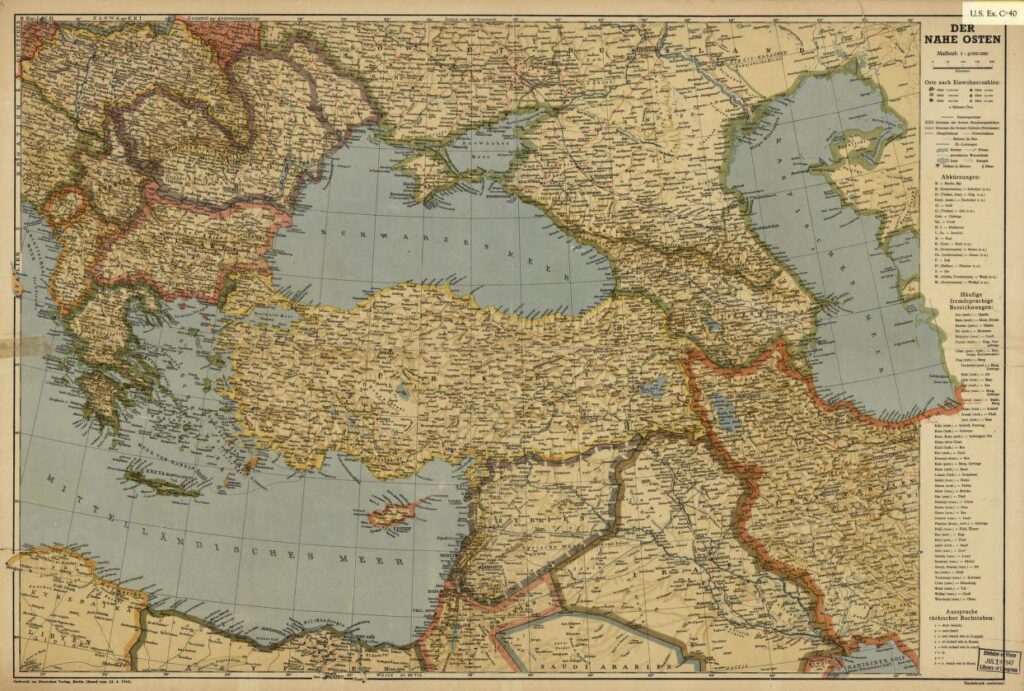
British Mandate
The fall of the Ottoman Empire at the end of World War I brought European control of the Middle East. A series of reports and declarations established a framework to provide context for the Middle East in World War II. With new control, European powers began deciding how countries’ borders should be divided among territories previously ruled under the Ottoman Empire. A new commission was established with Sir Mark Sykes, an orientalist, or a scholar of Asia, from Great Britain, and Charles Georges-Picot, the former French consul to Beirut. The Sykes-Picot agreement is significant because it establishes the borders for states and territories within the Middle East and signifies ownership of a critically strategic region for the French and the British, with Palestine falling under the British mandate.[1]
Lord Arthur Balfour implemented the Balfour Declaration in 1917, placing the territory under British authority. The Balfour Declaration served to establish a Jewish home within the state of Palestine, thus beginning years of contention between the British, Jews, and the Palestinians. There was a caveat to the declaration, as Balfour states, “It being clearly understood that nothing shall be done which may prejudice the civil and religious rights of existing non-Jewish communities in Palestine, or the rights and political status enjoyed by Jews in any other country. “[2]
By the 1930s, these mandates began falling apart. As violence increased in Palestine, the British appointed Lord Peel to start identifying a solution all parties could agree upon. In July 1937, the Palestine Royal Commission released the Peel Report. The report stated that the Arabs in Palestine desired their national independence and despised the establishment of a Jewish state. Lord Peel’s solution was to partition the territories between the Arabs and the Jews arriving from Europe, with the Arabs having a claim to land from Nazareth to Transjordan. At the same time, the Jews maintained territory surrounding Haifa and the sea. The Arabs would also be allowed access to the sea, while the British kept control of the Southern half of the country, including Jerusalem. This report was rejected by the Arabs and was accepted by the Zionist Congress with qualifications. The British Government ultimately dismissed the report in November 1938.
Jewish Refugees
Killing Jewish Germans was not the original plan of Adolf Hitler during the rise of the National Socialist Party in the 1930s. Hitler’s initial goal of elimination was not through extinction but through emigrating Jews to Palestine. In August 1933, the German Economic Ministry signed the Haavara Agreement. The agreement was between Germany, the Zionist Organization, and the Anglo-Palestine Bank.[3] Because Palestine was mandated as a home for the Jewish people, many Jews traveled to a land that held thousands of years of history for them. Thanks to the Balfour Declaration and the Peel Commission, it seemed the British were in agreeance that the Jews from Germany should come to this territory that Britain had acquired. With more Jews arriving in Palestine, there was a demographic change, and the Jews were gaining a majority. The British saw this as an opportunity to achieve their mandate and have a majority supporting the Empire.[4]
This new onslaught of Jewish refugees created fear among the Arab people who had lived in Palestine for generations. Refugees from Germany did not arrive in Palestine penniless, as they were able to buy back some of their assets from a Zionist Bank upon arrival. Richard L. Rubenstein in Jihad and Genocide says, “As a consequence of Jewish land purchase, thousands of Arabs experienced eviction, involuntary urbanization, and downward social mobility.”[5] The forced removal of Arabs from their homes, primarily in Jaffa, created an anger that could only be expelled through protest and violence.
Violence
The culmination of British influence, Arab resistance, and the Zionist Government led to a violent decade in the 1930s. Rene Wildangel says, “Arabs fighting Jews in the 1920s and 1930s had less to do with Germany, the rise of totalitarianism, and anti-Semitism in Europe than with post-First World War politics and the aspirations of an Arab national moment in the quasi-colonial situation of the [British] mandate.”[6] The Mufti is not solely responsible for said violence either. Other notable Arab figures in Palestine carried out attacks against Jews at a time when Husseini was working to establish his dominance, including Sheikh ‘Izz al-Din al-Qassam.
Syrian-born Sheikh ‘Izz al-Din al-Qassam was appointed as the imam of Haifa’s al-Istiqal Mosque after narrowly escaping the death penalty for his anti-French sentiments in Syria. Arab revolts intensified as Hitler pushed Jews from Europe, and they began buying land in Palestine. The land being purchased by the Jews led to the forced eviction of the Arabs who had lived there for decades. The anger felt by Arabs as they were forced from their homes led to violent revolts against the Jews and the British who were present due to the Mandate. Arab radicalization, resulting from the rise in Jewish land purchases, led to al-Qassam gaining a large following. Qassmites, or followers of al-Qassam, are responsible for the deaths of hundreds of British soldiers and Jewish citizens. While the Qassamites never revealed who they were led by, investigations revealed that al-Qassam was to blame. To defend themselves, Jews smuggled weapons into the country illegally and were caught. As a result, Arabs turned to guerilla warfare. Qassamites began slaughtering Jews in the streets of cities like Nablus and Haifa on November 2, 1935, the anniversary of the Balfour declaration. Al-Qassam, wanting to lead a strike in the North, wrote to Haj Amin al-Husseini to request he start a revolt in the South. At this time, Husseini declined, as he claimed only to be interested in a political rather than a military solution. After a fight with three policemen, two whom were Arabs and one Jew, the Jew was killed. On November 19, 1935, al-Qassam was found in a cave with two of his followers. Al-Qassam was killed and became a martyr, leaving Husseini to conclude he needed to make his ties closer to al-Qassam if he wanted the support of his followers.[7]
[1] Sir Mark Sykes, Charles Georges-Picot, The Sykes-Picot Agreement, January 3, 1916.
[2] Lord Arthur Balfour, Balfour Declaration, November 2, 1917.
[3] Rubenstein, Jihad and Genocide. Studies in Genocide, 66.
[4] Dalin et al., Icon of Evil: Hitler’s Mufti and the Rise of Radical Islam, 24.
[5] Rubenstein, Jihad and Genocide. Studies in Genocide, 66.
[6] Rene Wildangel’s More than the Mufti: Other Arab-Palestinian Voices on Nazi Germany, 1933-1945, and their Postwar Narrations is in Israel Gershoni’s Arab Responses to Fascism and Nazism, p. 102.
[7] Rubenstein, Jihad and Genocide. Studies in Genocide, 68.
